

Climate
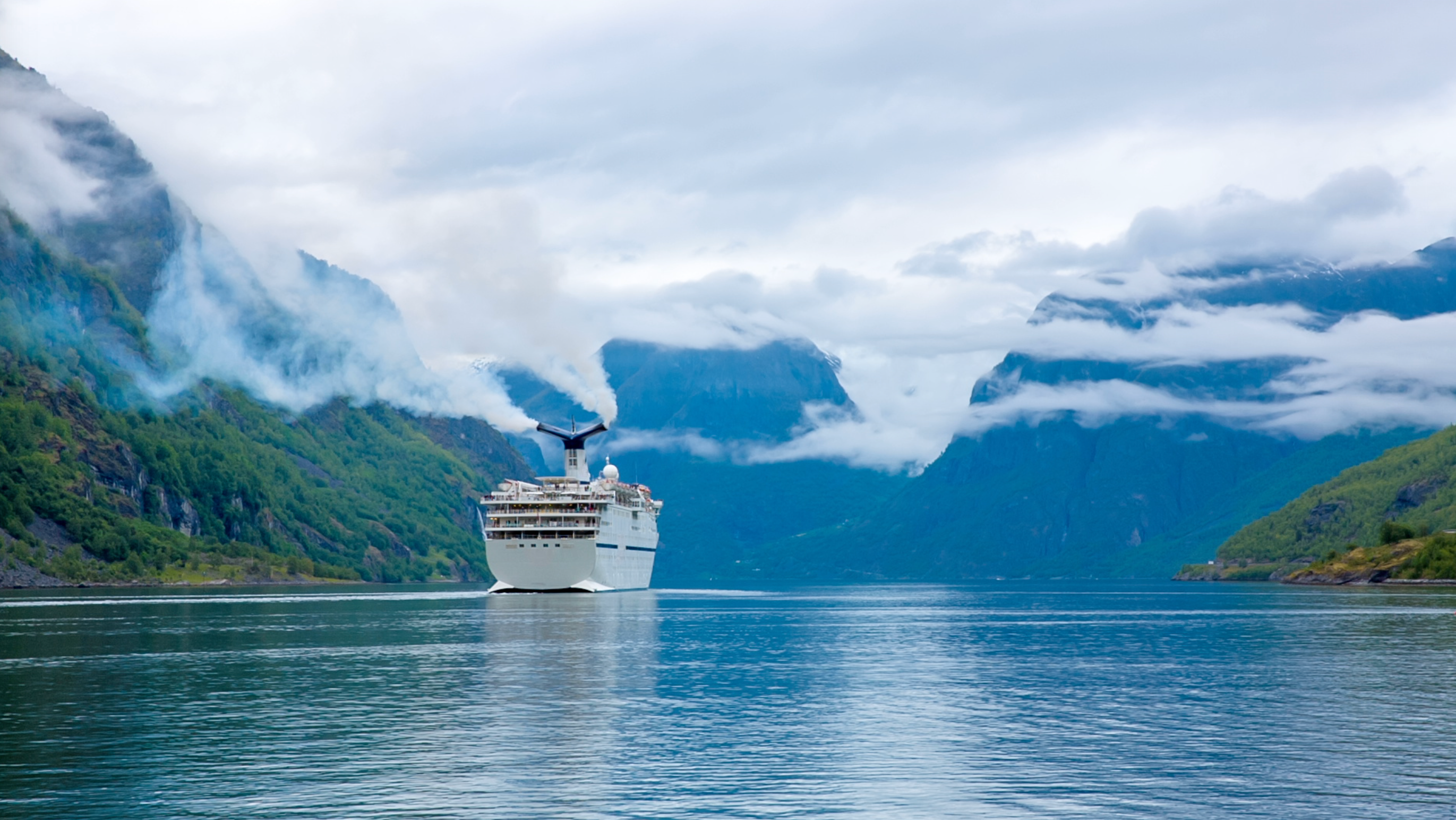
The annual climate pollution generated by Seattle’s cruise business is now half as big as the annual climate pollution generated by the entire city of Seattle:
Seattle: 5.7 million tons
Cruise business: 3 million tons
Over the past 25 years, Seattle’s cruise business has grown so large that its climate impact is now half as big as the annual climate impact of the entire city. The Port of Seattle has taken steps to reduce this impact, for example, by installing shore power and establishing a “Green Cruise Corridor,” but cruise’s climate impact is continuing to increase despite these efforts. Shore power eliminates less than one percent of the climate-harming emissions from cruise ships, and the Green Cruise Corridor is unlikely to significantly reduce emissions for many years to come, if ever. Meanwhile, the numbers of ships and passengers – and emissions – keep rising.
The Port of Seattle consistently points to the revenue and jobs that cruise generates, but is notably silent about cruise’s many costs. The research presented here, based on publicly available information, is an attempt to fill part of that gap.
A detailed description of the sources and methods used in this research can be found here: Sources and Methods
The 2025 Cruise Season
Between April and October of 2025, Seattle hosted 286 cruise ship calls, carrying almost 950,000 cruise passengers, primarily to Alaska. About 85% of these passengers – over 800,000 of them – flew to Seattle to start their cruises, and flew home again afterward.
Both cruise ships and airplanes emit significant amounts of greenhouse gases (GHGs); these gases trap heat in the atmosphere and are the main driver of the climate crisis. For each cruise ship that started and ended its voyage in Seattle, we counted the greenhouse gases emitted during its entire voyage. We also counted the emissions from the round trip flights that brought cruise passengers here, based on information from the Port about where they came from. Here is our estimate of the greenhouse gas emissions from the 2025 cruise season:
- GHG emissions from Seattle’s cruise ships:
- 1.9 million metric tons
- GHG emissions from associated flights:
- 1.1 million metric tons
- Total climate impact:
- 3 million metric tons
Units are in metric tons of carbon dioxide equivalent (mtCO₂e), rounded to the nearest hundred thousand, and measured over a 100-year time horizon. “Carbon dioxide equivalent” (CO₂e) is a unit that provides a common way to measure the climate impact of different greenhouse gases, such as carbon dioxide, methane, and nitrogen oxides, each of which has a different impact on the climate.
How significant are 3 million metric tons of greenhouse gases?
For context, we can compare these numbers to the annual GHG emissions from the city of Seattle. As of April, 2026, the most recent figures for Seattle’s emissions are from its 2022 Community Greenhouse Gas Emissions Inventory. Note that Seattle’s emissions are for the entire year, while the 2025 cruise ship season lasted only six months, from mid-April to mid-October.
Seattle counts two categories of emissions: core emissions and expanded emissions.
Seattle’s core emissions in 2022 were 2.9 million metric tons.
Core emissions (p.11) are those from residential and commercial buildings (for space and water heating, cooking, and electricity) and all ground transportation – cars, trucks, buses – within Seattle city limits.
In six months, Seattle’s cruise business was responsible for as much climate pollution as was produced in a whole year by all of Seattle’s residential and commercial buildings, and all of its cars, trucks, and buses.
Seattle also measures the city’s “expanded emissions” (p.13). These consist of core emissions plus those from flights taken by Seattle residents and emissions from industry located in Seattle. Even with these counted, Seattle’s cruise sector is responsible for half as much climate pollution in six months as the entire city produces in a year.
Expanded emissions, Seattle, 2022: 5.7 million metric tons
Emissions are increasing
The global cruise industry is expanding, building more ships and more cruise terminals – including several in Alaska – and aggressively seeking new customers. CLIA, the trade group for the global cruise business, forecasts a 20% increase in cruise passengers between 2024 and 2028, from 34.6 million to almost 42 million. This expansion is outpacing the industry’s current efforts to reduce emissions. These efforts include shore power, route adjustments, waste reduction, and the use of alternative fuels. Unfortunately, the most widely used alternative fuel is liquefied natural gas (LNG), which, although touted as a climate solution, actually has a bigger climate impact than conventional marine fuels.
This global expansion affects Seattle. The Port of Seattle’s 2026 budget (p.74) notes that weekend demand for cruise berths now exceeds capacity, and cites “continued interest in expansion in Seattle” as an “opportunity.” This suggests the possibility of Seattle building a new, additional, third cruise terminal; notably, 29 acres at Terminal 46 have been set aside for this use. Should an additional cruise terminal be built, it would result in an additional huge jump in both the number of cruises Seattle hosts and the resulting damage to the climate.
The table below shows the increase in the number of cruise sailings, passengers, and resulting GHG emissions from Seattle’s cruise business over the last few years. Total GHG emissions, shown in the right-most column, increased 57% between 2019 and 2025. Emissions will continue to increase in 2026, when Seattle will host 320 home port sailings.
GHG emissions are in million of metric tons of carbon dioxide equivalent.
| # home port sailings | # home port pax | # pax flying | GHG from ships | GHG from flights | Total GHG | |
| 2019 | 200 | 559,000 | 481,000 | 1.1 | 0.8 | 1.9 |
| 2024 | 253 | 794,000 | 683,000 | 1.6 | 0.9 | 2.5 |
| 2025 | 286 | 944,000 | 812,000 | 1.9 | 1.1 | 3.0 |
GHG = greenhouse gasses. These are in millions of metric tons of carbon dioxide equivalent (CO₂e), rounded to the nearest hundred thousand
pax = passengers, rounded to the nearest thousand
Home port sailings refers to ships that start and end their journeys in Seattle
Shore power eliminates less than 1% of these emissions
The use of shore power eliminates less than 1% of greenhouse gas emissions from Seattle’s cruise ships. In 2025, about two-thirds of the cruise ships that came to Seattle used shore power, but even if all ships used shore power, it would eliminate less than 1% of the ships’ emissions.
Consider cruise ship emissions from the 2025 season (emissions from cruise ships only, not including those from airplane flights). This table shows emissions in metric tons of carbon dioxide equivalent.
| 2025 GHG emissions from cruise ships | GHG eliminated by using shore power | Remaining GHG emissions (i.e., NOT eliminated) | Percent of GHG eliminated by shore power |
| 1,886,448 | 6,444 | 1,880,004 | 0.34% |
Note that this is not 34 percent of emissions that are eliminated: it’s 0.34 percent, a little more than one-third of one percent.
Shore power allows suitably equipped ships to plug into Seattle’s relatively clean electrical grid while they’re docked: they can turn off their engines and stop burning polluting fuel for about 7 out of the 10 hours that they’re at berth. They can’t use shore power the entire 10 hours because it actually takes about an hour and a half to connect to shore power, and another hour and a half to disconnect. All three of Seattle’s existing cruise berths have been equipped with shore power since 2025, but not all cruise ships that come here are equipped to use it. By 2027, the Port of Seattle will require all home-ported ships (those whose journey begins and ends here) to be equipped to use shore power, and to actually use it, although it’s not clear how or whether this requirement will be enforced.
However, as stated above, even if and when all ships use shore power, it will still eliminate less than 1% of the greenhouse gases that the ships collectively emit on their journeys.
In addition to emitting climate-harming greenhouse gases, cruise ships also emit air pollutants that harm human health, including:
- sulfur and nitrogen oxides, which irritate the respiratory system, contribute to heart and lung disease, and increase the risk of cancer;
- small particulate matter (PM 2.5), which causes respiratory disease, cardiovascular problems, lung cancer, and premature death.
These emissions occur throughout the ships’ journeys, delivering health-harming pollution to communities along the entire route to Alaska and to the people onboard the ships. But at least for the seven hours the ships use shore power, people who live, work, and visit near Seattle’s cruise terminals are spared this pollution.
What about the “Green Cruise Corridor?”
In 2022, the Port of Seattle formed a “Green Cruise Corridor,” partnering with other ports on the Alaska route, major cruise lines, and several maritime technology companies. This is an example of a “green shipping corridor,” whose goal is to “explore zero-emission strategies” to address shipping’s massive – and growing – climate impact.
Like most of the 84 green shipping corridors around the world, as of 2025, the Green Cruise Corridor has so far had no effect on lowering emissions. The Corridor is unlikely to significantly lower emissions for many years to come, if ever. The Corridor is speculative, its ultimate goal allows for continued emissions, and there are no enforcement mechanisms.
- The Corridor’s first project is to assess the feasibility of using green methanol on four cruise ships by 2032. If this fuel is found to be infeasible, emissions reductions will be pushed off further into the future.
- The Corridor’s goal is to be “net zero” by 2050, but it’s not clear what “net zero” means. It could mean that cruise ships will continue to emit vast amounts of GHGs, but by 2050, they will start buying “carbon offsets” for them. It is important to note that the majority of carbon offsets have been shown overwhelmingly to be ineffective, failing to provide real and additional emissions reductions.
- Cruise industry expansion is outpacing emissions reductions. CLIA, the global cruise trade group, forecasts a 20% increase in cruise passengers between 2024 and 2028, from 34.6 million to almost 42 million; this expansion is overwhelming current incremental emissions reductions, like shore power and route and operational adjustments.
- Cruise companies participating in the Green Cruise Corridor claim that using LNG (liquefied natural gas) as a fuel results in immediate GHG emissions reductions, reducing carbon emissions up to 20%. (See Carnival Corporation’s “Destination: Net-Zero Greenhouse Gas Emissions” and their page on LNG.) In fact, the International Council on Clean Transportation has shown that cruise ships using LNG have higher GHG emissions than those using conventional fuels: carbon emissions are lower, but methane emissions are higher, and methane is a more potent greenhouse gas than carbon dioxide.
Do these GHG emissions show up in any official inventories?
No. The Port of Seattle, the city of Seattle, King County, and Washington State all publish greenhouse gas emissions inventories, but almost none of the GHG emissions from ships and airplanes are included. The Port of Seattle’s inventory only includes maritime emissions that occur within the Puget Sound Airshed, which runs just to the Canadian border, and through the Strait of Juan de Fuca. See Puget Sound Maritime Air Emissions Inventory 2024, Vol. 1, p. 33, for a map of this airshed. Note that this inventory measures emissions for the year 2021, despite the “2024” in the title; it was published in the year 2024. The King County inventory includes airplane emissions, but does not separate out flights taken by cruise passengers.
What does the Port of Seattle say about the climate impact of cruises?
The Port does not count most of the GHG emissions from cruise ships; their inventory only reports emissions within the Puget Sound Airshed, as mentioned above. Not surprisingly, the number they report is smaller than what we are reporting here. The most recent inventory that they rely on, the Maritime Emissions Inventory for the year 2021, is particularly non-illuminating because cruise traffic was down significantly in 2021 due to the Covid pandemic. In addition, in considering cruise’s climate impact, the Port does not account for the GHG emissions from flights that bring cruise passengers to Seattle.
Notably, the Port’s guiding document, the “Century Agenda,” includes a goal of reducing greenhouse gas emissions from ships and planes 50% by 2030, compared to a 2007 baseline. Increasing numbers of cruise ship calls, with the associated increase in the number of flights and the amount of GHG emissions, runs directly counter to this goal. As of 2022, ship emissions were up 31% from 2007, and they are on track to keep increasing: in 2026, Seattle is expecting 330 cruise ship calls.
What can be done
The mission statement of the Port of Seattle calls for “the promotion of economic opportunities and quality of life in the region by advancing trade, travel, commerce, and job creation in an equitable, accountable, and environmentally responsible manner.”
Seattle’s cruise ship business is neither equitable, accountable, nor environmentally responsible. Seattle Cruise Control has created An Agenda for the Port, a collection of actions that would align the Port’s conduct with its mission statement. These actions include capping the number of cruise sailings and reducing cruise’s greenhouse gas emissions on a step-wise schedule, in line with proposed federal legislation.
You can tell the Port Commissioners, who are elected representatives of the people of King County, that you expect them to protect people and planet from the harms of the cruise industry. Information on how to attend a hybrid Port Commission meeting or submit written or spoken comments is here.
Sign up here for our mailing list, to receive updates and calls to action.