
Marine Ecosystems
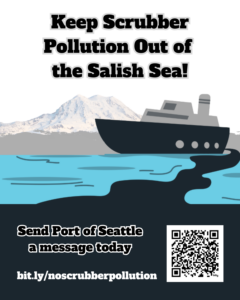
The majority of water pollution from cruise ships – over 95% of it – is something that most people have never heard of: scrubber waste. Scrubbers use vast quantities of seawater to continuously “scrub” toxic contaminants from ships’ exhaust, and then dump that now-polluted water directly back into the ocean. Seattle’s cruise ships discharge over 4 billion gallons of toxic, acidic scrubber wastewater each year, harming the marine environment, wildlife, fisheries, and people’s health. Other sources of water pollution from cruise ships include “greywater,” which is dirty water from sinks, showers, laundry and kitchens; sewage; garbage; and hazardous waste. Learn more about scrubbers, the harm they cause, and potential solutions, here.
Cruise ships’s engines and propellers generate deafening underwater noise, making it harder for whales – including the critically endangered Southern Resident killer whales – to find food and mates.
Worldwide, cruise ships, along with other large vessels, strike and kill an estimated 20,000 or more whales annually. These collisions, often fatal due to blunt trauma or propeller injuries, frequently occur in high-traffic shipping lanes and feeding areas, such as the U.S. West Coast and Southeast Alaska.
Cruise ships emit vast amounts of greenhouse gases, the primary driver of climate change.
-
- Climate change results in a warmer atmosphere, and some of the extra atmospheric heat gets absorbed by the oceans. In turn, warmer ocean water can’t hold as much oxygen, and low oxygen levels result in serious harm to marine life, including stunted growth, slow development, impaired reproductive abilities, deformities, and death.
- The oceans also absorb some of the excess carbon dioxide that ships emit into the atmosphere. When carbon dioxide mixes with seawater, it creates carbonic acid, making the oceans more acidic. Increased acidity disrupts the entire marine ecosystem. It eats away at the minerals used by oysters, clams, lobsters, shrimp, coral reefs, and other marine life to build their shells and skeletons. Mussels, sea urchins, and crabs start to dissolve their protective shells to counter elevated acidity in their body fluids. Increased acidity also makes it harder for sea creatures to stay healthy, and to survive as larvae.
These rapid changes to the oceans are resulting in population declines for whales, shellfish, salmon, and kelp beds, and other sea life, and disruption of the entire marine ecosystem.
Take action! Send the Port an email today:
Keep scrubber pollution out of the Salish Sea!
Learn more:
- Regulating the West Coast Cruise Industry: Canada at the Low Water Mark guides you through the water pollution left by cruise ships on their voyages from Seattle to Alaska. By Stand.earth and Western Environmental Law Center.
- Cruise Ship Invasion takes you on a similar voyage, but with video! It explores a wider variety of harms.
- Here’s what the EPA and NOAA have to say about how ocean acidification affects marine life.