
Scrubbers: Turning air pollution into water pollution
What are scrubbers?
After oil is refined to make various kinds of fuel – gasoline, diesel, and jet fuel for cars, trucks, ships, and airplanes – what’s left over, literally at the bottom of the barrel, is a tarry sludge called heavy fuel oil. This waste product contains 4,000 times as much sulfur as the gasoline used by cars.
Heavy fuel oil is the fuel of choice for most cruise ships.
Heavy fuel oil is so dirty that burning it violates sulfur emission standards for air pollution. But rather than switching to cleaner, more expensive fuel, most cruise ships take advantage of a legal loophole: they save money by continuing to burn heavy fuel oil, and they use a scrubber to meet air emission requirements.
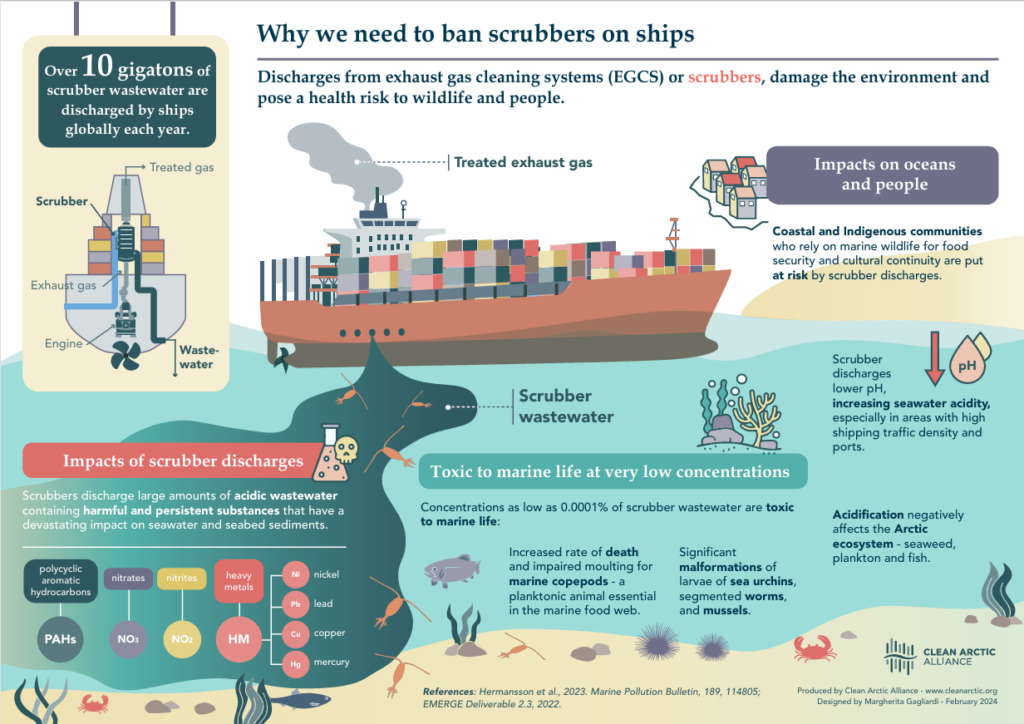
A scrubber is a device that turns air pollution into water pollution. ☠️
Scrubbers (also known as “exhaust gas cleaning systems” or EGCS) use millions of gallons of seawater to “scrub” toxic contaminants out of ship’s exhaust, then dump the now-polluted water back into the ocean.
Impacts of scrubbers
A large body of scientific work shows that scrubber wastewater poses serious dangers to the marine environment, wildlife, and people’s health.
- Scrubber wastewater is highly toxic, significantly hotter, and up to 100,000 times more acidic than the surrounding ocean.
- Even at extremely low concentrations, the toxins in scrubber waste can harm organisms at the base of the marine food chain. Toxins become more concentrated and persist up the food chain, affecting forage fish, salmon, people who eat seafood, and seabirds and marine mammals – such as endangered Southern Resident killer whales – who rely on fish for survival.
- Washington waters are already suffering from acidification due to climate change, with particularly harmful effects on shellfish. Discharging vast quantities of highly acidic scrubber wastewater makes this problem worse.
- Washington’s marine waters support more than 170 species of resident and migratory birds, as well as the fisheries and communities that depend on clean, healthy ecosystems. Toxins from scrubber waste lead to declining seabird populations: seabirds with higher contaminant levels are less likely to breed, produce eggs that hatch, and have fledglings that survive to leave the nest.
- Scrubbers use incredibly powerful pumps to continuously pull up millions of gallons of seawater; this seawater is teeming with marine life. It is unlikely that any of this life survives its journey through the scrubber: larger fish are crushed against the scrubber’s filter, while plankton are sprayed into a hot, acidic chamber, full of toxic gases.
- Ships burning heavy fuel oil with scrubbers release more airborne black carbon – microscopic, soot-like particles – than those using cleaner fuels, worsening human health conditions like asthma, cardiovascular disease, and cancer.
Scrubbers don’t reduce pollution: they transfer it from air to water, putting marine life, fisheries, birds, and communities at risk.
The current threat
In 2021, the main cruise companies that come to Seattle agreed to temporarily “pause” their discharge of scrubber waste into Puget Sound, until a new, local study could be completed.
Carnival Cruise financed a study that claims to show that scrubber discharge has no impact on the marine environment of Puget Sound! This is an example of an industry-funded study designed to produce a specific result, in order to allow harmful behavior to continue. Cruise companies are likely to use this study to justify backing out of the current scrubber discharge pause so they can go back to burning cheap, dirty fuel and dumping toxic scrubber waste into the Salish Sea.
If cruise lines do withdraw from their agreement to pause scrubber discharge, we can expect them to dump approximately 300 million gallons of polluted scrubber waste into Washington waters during the 2026 cruise season.
Take action!
Send the Port an email today: Keep scrubber pollution out of the Salish Sea!
Addressing the Problem: Potential solutions
Ultimately, the International Maritime Organization (IMO) – the UN agency that regulates international shipping – needs to ban the use of scrubbers. But both the IMO and – at the national level – the United States Environmental Protection Agency, have dragged their feet on reining in scrubber harm.
While continuing to push for national and international action, advocates are working, and making progress, at the local, Port, and state level.
Around the world, over 90 jurisdictions in 45 countries have banned or restricted the use of scrubbers and the discharge of scrubber waste, including California, Connecticut, Mexico, Egypt, Sweden, Denmark, and France.
In 2025 and 2026, Washington State legislators considered House Bill 1652 / SB 1599, which would effectively end the use of scrubbers by all ocean-going vessels – not just cruise ships – in state waters. Stay tuned for ways to support the bill during the 2027 legislative session!
Action at the local, regional, and national level can drive progress and increase global momentum for the needed ban worldwide.
Learn more:
- Reason No. 9 Not To Cruise: Bunker Fuel – Nasty Tar Sludge! – a personal look at fuel from an oil man’s son. Heavy fuel oil, also called bunker fuel, is the reason scrubbers were invented.
- Poison in the Water – good overview of threats from scrubber waste, compiled by Pacific Environment (2025)
- Ship Pollution: From Air to Ocean – additional studies on scrubber waste harms (2024)
- Air Emissions and Water Pollution Discharges from Ships with Scrubbers by the International Council on Clean Transportation (2020)
- No Scrubs: Countries and Ports where Restrictions on EGCS Discharges apply (2026)